Most Companies Don't Have an AI Problem. They Have a Workflow Problem.
The standard advice is to pick the right AI model, hire a data team, and build a pilot. The advice is wrong. Or at least, it starts in the wrong place. The number one predictor of AI ROI, according to McKinsey's Quantum Black research, is whether a business reimagined a workflow end to end with AI. Not added AI to a workflow. Reimagined it.
Eighty-four percent of companies have not done this. They bought tools. They ran pilots. They sat through vendor demos. And then they plugged AI into processes designed in 2015 and wondered why the results feel flat. The problem was never the model. The problem is the work itself.
The workflow is the product, not the model
Your ops manager opens Monday's inbox to 400 unread support tickets. The team's current process: a human reads each ticket, categorizes it, assigns it, and routes it to the right person. Average handle time is six minutes per ticket. Forty hours of human labor per week just on triage.
Now someone adds an AI classification tool. The model reads each ticket and suggests a category. A human still reviews the suggestion, still assigns it, still routes it. Handle time drops to four minutes. A 33% improvement. Not bad. But the workflow is the same. The human is still in every step. The AI just made one step slightly faster.
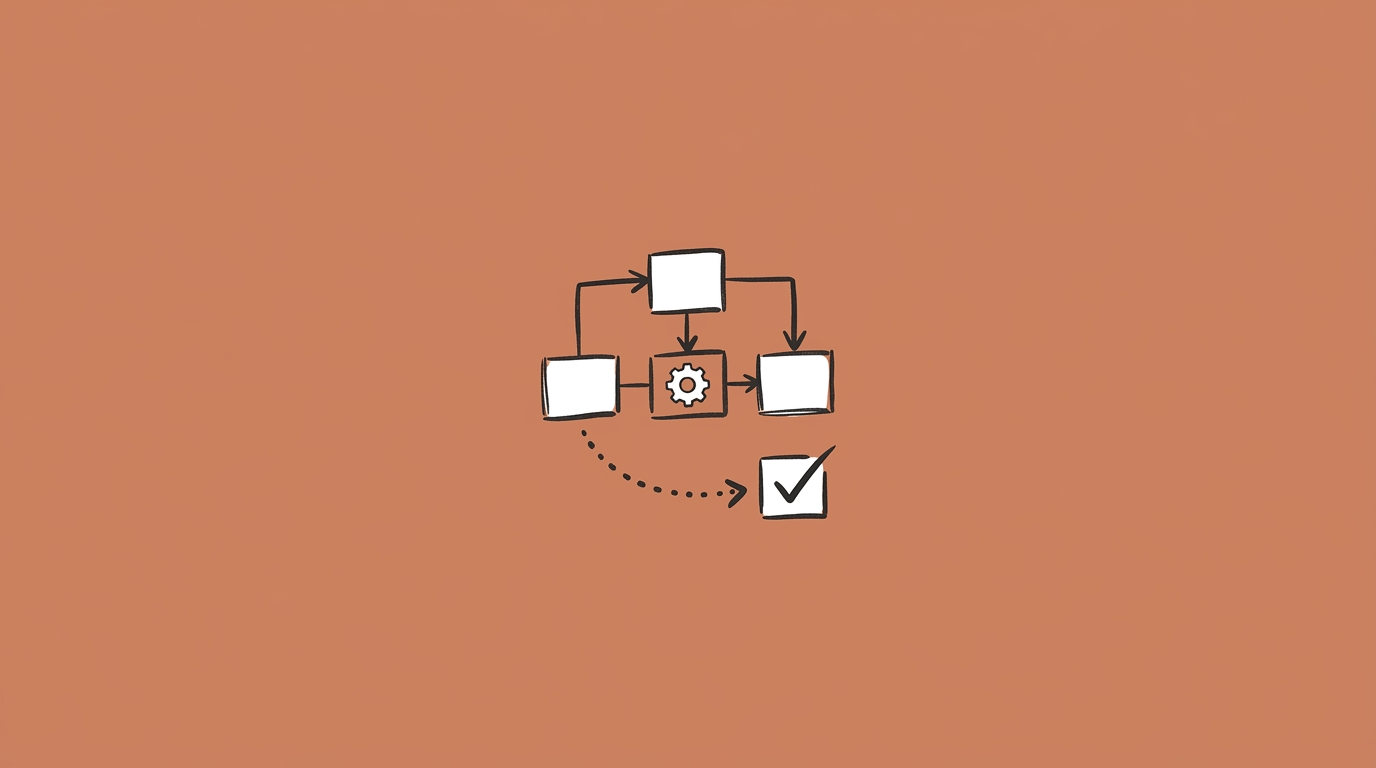
Reimagined end to end: the model reads the ticket, classifies it, checks confidence against a threshold you set (say 90%), auto-routes high-confidence tickets directly to the assigned team, and flags low-confidence tickets for human review. Humans now handle 40 tickets instead of 400. Handle time for the human drops to near zero on 90% of volume. Not a 33% improvement. A structural change.
The model in both scenarios can be identical. Same provider. Same cost. Same accuracy. The difference is the workflow.
This is why MIT's 2025 study found that 95% of corporate AI projects fail to deliver expected ROI. The models work. The workflows don't.
Model selection is the least important decision
Teams spend 80% of planning energy on model selection because it feels concrete. Which provider? What benchmark scores? How much per million tokens? These are answerable questions, and answering them feels like progress.
But the model is 10-20% of the project. The 90% that decides success is harder and less fun: task definition, data quality, user involvement, workflow design, evaluation criteria, governance policy, and the willingness to change how people actually do their jobs.
Say a mid-size fintech runs 12,000 support tickets a month. They spend three weeks evaluating five language models. They run benchmarks. They compare pricing. They pick a model. It takes another two weeks to connect it to their ticketing system.
Then reality hits. The model classifies tickets well, but the routing logic is hardcoded from 2019 and doesn't match current team assignments. The model's output goes into a queue that nobody checks because the old queue was already overflowing. And the governance policy says all AI outputs must be reviewed by a senior agent, so the volume stays exactly the same.
The model was never the bottleneck. The bottleneck was a routing table nobody updated, a queue nobody monitored, and a review policy designed for a different tool.
Honestly, most teams overthink this. Don't start with the model. Start with the workflow map. Which steps are humans doing that a system could do faster, more consistently, and at lower cost? Which steps require human judgment and should stay human? Where does the handoff happen, and what confidence threshold triggers it?
Then pick the cheapest model that clears the quality bar for that specific task. The model is a component. The workflow is the product.
Why workflow redesign is the hardest step
If workflow redesign is the number one predictor of ROI, why do 84% of companies skip it?
Because workflow redesign requires changing how people work. And changing how people work is organizational change, not technology change. It involves different teams, different incentives, and different politics.
Harvard Business Review's 2026 research on AI adoption identified four employee segments based on their beliefs and anxieties about AI:
- Visionaries (40%): High belief in AI's value, low personal risk perception. These are your early adopters.
- Disruptors (30%): High belief, high risk. They see the value but fear for their own position. They use AI aggressively but resist it emotionally.
- Endangered (20%): Low belief, high risk. They don't think AI works well and they feel threatened by it. Hardest group to move.
- Complacent (10%): Low belief, low risk. AI feels abstract to them. They will not engage unless forced.
The disruptors are the most interesting group. HBR found they use AI for 65% of their job duties, more than any other group. But they also show 2.2x higher resistance to organizational AI initiatives. They are using AI to protect themselves, not to improve the workflow. Compliance without commitment. It looks like adoption. It produces no structural improvement.
Workflow redesign requires the visionaries to lead, the disruptors to feel safe enough to contribute honestly, the endangered to receive role-specific training that addresses their real concerns, and the complacent to see concrete results from their peers. A change management problem, not something a vendor webinar will solve.
This is the honest answer about why most AI projects stall, and it is the pattern I keep seeing in every engagement. The technology works. The organization doesn't.
What a redesigned workflow actually looks like
Step by step, when it works right. No company names, because the pattern is the same regardless of industry.
Before AI: A paralegal reviews a 300-page contract. They read every page, flag relevant clauses, compare against a checklist of 40 standard terms, note missing items, and draft a summary for the attorney. Time: 6-8 hours per contract. Cost: roughly $250-400 in billable time.
AI bolted on (not redesigned): The paralegal uploads the contract to an AI tool. The tool highlights potentially relevant clauses. The paralegal still reads every page because they don't trust the tool's completeness. They still compare against the checklist manually. Time: 5-7 hours. The tool saved 45 minutes. The process is the same.
Workflow redesigned end to end: The contract enters a pipeline. The AI model extracts all 40 standard clauses, compares them against the checklist, flags missing terms, and generates a structured summary with confidence scores per clause. High-confidence extractions (above 92%) go directly into the summary. Low-confidence extractions get queued for human review. The paralegal reviews only the flagged items and the final summary. Time: 90 minutes. Cost: roughly $60 in billable time plus $0.80 in model costs.
Same model. Same contract. The difference is that the second version redesigned who does what, when, and why. The paralegal's job changed from "read everything" to "review exceptions." That is not an efficiency gain. It is a role transformation.
And here is the part most guides leave out, the part that frustrates me about how AI gets sold: the redesigned version took three iterations to get right. The first version had confidence thresholds set too low and missed clauses. The second version over-flagged and created more human review work, not less. The third version, after tuning thresholds on 200 real contracts, hit the balance. Workflow redesign is not a one-time event. It is a loop.
When workflow redesign does not work
Not every process should be redesigned with AI. Worth saying clearly because the enthusiasm can run ahead of the math.
Low volume kills ROI. If your team processes 10 contracts a month, the paralegal workflow above saves maybe 50 hours. That sounds good until you account for the 80 hours of setup, testing, and iteration needed to build the pipeline. At 10 contracts a month, you break even in month two. At 3 contracts a month, you never break even. Don't build a pipeline for a task that takes 10 minutes a day.
Unstructured judgment calls resist automation. A venture capital partner evaluating a startup pitch is not doing a task that decomposes into classifiable steps. The judgment draws on every variable at once, depends heavily on context, and relies on pattern recognition from years of experience. AI can summarize the pitch deck. It cannot replace the evaluation.
High-stakes single decisions need humans. Firing an employee. Approving a merger. Deciding whether to pull a product from market. These are low-volume, high-consequence decisions where the cost of one wrong AI output exceeds the cost of every human hour you would save. Keep humans in the loop not as reviewers but as deciders.
The trap is treating AI as a universal optimizer. It is not. It is a tool for specific types of work: high-volume, repetitive, text-based, verifiable, and measurable. Everything else needs a different approach.
Start here
One workflow. The highest-volume, most repetitive process in your business. Map every step. Identify which steps are classification, extraction, routing, or summarization. Those are the steps AI handles well. Identify which steps require judgment, context, or relationship management. Those stay human.
Build the new workflow. Set confidence thresholds. Run 50 real examples. Grade every output. Fix what breaks. Run 50 more. (The full readiness checklist is in How Many Companies Are Actually Ready for AI.)
The model is a decision you make in week two. The workflow is a decision you make in week one. Get the order right, and the rest follows.
Sources
- McKinsey Quantum Black — The State of AI (2025)
- Harvard Business Review — Why AI Adoption Stalls, According to Industry Data (February 2026)
- MIT — Why 95% of Corporate AI Projects Fail (2025)
- Docebo — The AI Readiness Gap Is Growing (2026)
- a16z — Where Enterprises Are Actually Adopting AI (April 2026)
- Gartner — Worldwide AI Spending Will Total $2.5 Trillion in 2026

Founder, Tech10
Doreid Haddad is the founder of Tech10. He has spent over a decade designing AI systems, marketing automation, and digital transformation strategies for global enterprise companies. His work focuses on building systems that actually work in production, not just in demos. Based in Rome.
Read more about Doreid