AI Content Repurposing: How to 10x Output Without 10x Cost
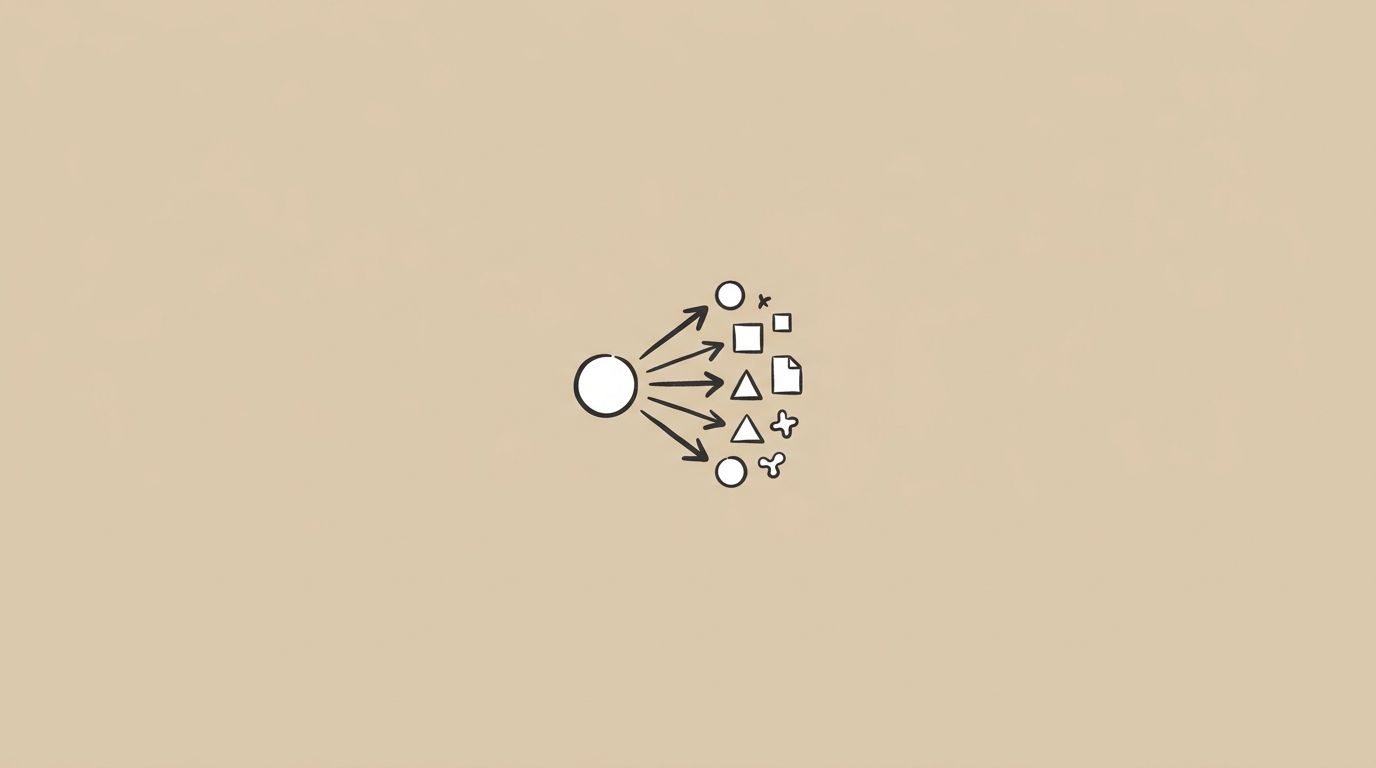
The biggest leverage in AI marketing in 2026 isn't generation. It's repurposing. The team that researches once, drafts once, then distributes that work into 15-20 platform-appropriate units captures 10x the audience reach for roughly 1.5x the cost. The math is favorable in a way that's hard to match anywhere else in marketing.
This article is the production-line architecture. The asset count, the per-unit cost picture, the sourcing discipline that holds quality across formats, and the channels where repurposing genuinely wins.
The production-line frame
Stop thinking about content as one-asset-per-channel. Start thinking about it as one-research-pass-per-pillar with multi-channel distribution. The shape:
- One pillar article (1,500-3,000 words) does the heavy lifting. Original research, primary sources, opinion, position. This is the 70% of work.
- Derivative assets (12-20 per pillar) translate the pillar into platform-native formats. This is the 20% of work, dramatically accelerated by AI.
- Distribution and amplification schedules and posts the assets. This is the 10% of work.
The AI sits in step 2. It doesn't replace the original research. It replaces the manual translation of research into platform formats.
The 15-asset map from one pillar
A typical 2,000-word pillar article in 2026 supports this many derivative units:
Long-form text channels:
- Long-form blog post (the pillar itself)
- Short-form blog summary (600-800 word version, often a different angle)
- Email newsletter feature (300-500 word adapted)
- Sales enablement one-pager (PDF for the sales team)
Social posts:
- LinkedIn long-form post (600-1200 chars from the pillar's strongest section)
- LinkedIn carousel (10-slide deck of the pillar's framework)
- Twitter/X thread (15-25 tweets covering the framework)
- Instagram carousel (10-slide visual version)
- Threads post (similar to Twitter, different audience)
Audio and video:
- Podcast or audio version (AI-generated narration via ElevenLabs or similar)
- YouTube short (60-second visual summary of the central insight)
- YouTube long-form (10-15 minute walkthrough if the pillar warrants)
Owned assets:
- Slack/community post (for your community channels)
- Internal training doc (for sales and customer success teams)
- Partner newsletter snippet (for affiliate or partner programs)
That's 15 distribution units from one pillar. Not every pillar supports all 15 — long-form video adds production cost, audio adds narration cost, podcast distribution adds podcast strategy. Pick the 5-8 that fit your audience and team capacity.
Where AI actually accelerates the 20%
Each derivative format has a different AI play:
Blog summary. Prompt with "summarize this article for [different audience], emphasizing [different angle]." Often produces a publishable draft in one pass.
LinkedIn post. Prompt with "extract the strongest single insight from this section as a 600-character LinkedIn post in [author's voice]. Strong hook. Specific number or example. End with a question or call-to-engagement."
Twitter thread. Prompt with "convert this article's framework into a 15-tweet thread. Each tweet stands alone. Lead tweet with hook. Closing tweet with takeaway."
Carousel slides. Prompt with "convert this article's framework into 10 slide titles plus one-sentence body text per slide. First slide is hook, last slide is action."
Audio narration. Use ElevenLabs or similar with the pillar text. Voice clone or branded voice if budget supports.
Each of these takes 5-15 minutes with a well-tuned prompt. Without AI, each takes 30-60 minutes of human time. The compression is real and consistent.
The sourcing discipline that holds quality across formats
The risk in repurposing is that derivative assets drift from the source. The Twitter thread quotes a statistic; the statistic was hallucinated by the AI; nobody checked because they were generating in volume. The LinkedIn post takes a position the original article was more nuanced about; it goes viral; the position is overstated.
The discipline that prevents this:
The pillar is the canonical source. Every claim, every statistic, every quote in any derivative asset must trace back to a section of the pillar that's already verified. If a derivative wants to make a claim the pillar didn't, the claim doesn't go in.
Numbers get checked twice. Once in the pillar against the primary source. Once in the derivative against the pillar. Either pass can catch a hallucinated statistic.
Quotes preserved verbatim. Don't let the AI summarize quotes. Pull the exact quote from the pillar.
Position consistency. If the pillar is nuanced about a claim, the derivative is nuanced too. Don't let punchy social formats erode the qualifications that make the position defensible.
This discipline takes 15-20 minutes per derivative for verification. Skipping it produces the AI-generated misinformation pattern that hurts brand trust over time.
The cost math
For a typical 2,000-word pillar plus 12-15 derivatives:
Without AI, all human:
- Pillar: 8-12 hours of writer time
- Each derivative: 30-60 minutes
- Total: 14-25 hours per pillar package
With AI assistance:
- Pillar: 8-12 hours (AI doesn't change this much; the pillar is the 70% of work that's research and editing)
- Each derivative: 10-20 minutes including verification
- Total: 10-15 hours per pillar package
With AI and a serious prompt library:
- Pillar: 8-12 hours
- Each derivative: 5-10 minutes
- Total: 9-13 hours per pillar package
The compression is meaningful. A team that previously produced 4 pillar packages per month per writer can produce 6-8 with AI assistance and a tight workflow. That's 50-100% more distribution capacity from the same headcount.
Where the strategy fails
Two failure modes I see repeatedly.
Repurposing without a pillar. Some teams skip the pillar and try to generate derivatives directly from prompts. This produces 15 thin assets that all sound the same and have no anchor. The pillar is what gives the derivatives substance. Skip it and the math collapses.
Channel-blind distribution. Pushing the same content with light reformatting to every channel ignores that LinkedIn audiences differ from Twitter audiences differ from your email list differ from your YouTube subscribers. Each derivative needs platform-specific thinking, not just format conversion. The AI handles the format conversion; the platform-specific angle is human judgment.
What to do this week
If you're starting AI content repurposing seriously:
- Audit your current ratio. How many distribution assets do you produce per piece of original research? If it's under 5, you're underrepurposing.
- Pick your three highest-leverage derivative formats. For most B2B teams, that's LinkedIn long-form, Twitter thread, and email newsletter. For B2C, often Instagram carousel, YouTube short, and email.
- Build prompts for each. Iterate over a month. Get the prompts to a state where output requires light editing rather than full rewriting.
- Set the production rhythm. One pillar per week with the three derivatives is a sustainable starting point. Add formats as the workflow gets reliable.
The bigger pattern
Marketing in 2026 is fragmenting across channels faster than any team can keep up with originals. The teams who win aren't the teams creating the most original content. They're the teams whose original content travels furthest. AI repurposing is the leverage that lets a small team distribute like a big team without sacrificing the originality that makes the content worth distributing.
Source once. Distribute many. Verify everything. The math works for as long as the pillar holds up.
Frequently Asked Questions
How many assets can I realistically get from one piece of pillar content?
12-20 distribution units from a single 2,000-word pillar article: long-form blog post, short-form blog summary, LinkedIn post, Twitter/X thread, Instagram carousel, YouTube short, podcast script, audio version, email newsletter, sales-enablement one-pager, internal training doc, partner newsletter snippet. Not all will land on every channel; pick the 5-7 that fit your audience.
Doesn't repurposing produce duplicate content penalties?
Across different channels (LinkedIn, Twitter, YouTube, blog), no — each platform has its own content rules and there's no cross-platform duplicate penalty. Within Google search results, yes — multiple pages on your own site with substantially identical content can hurt rankings. Solve via canonical tags or by genuinely differentiating the on-site versions.
What's the right ratio of pillar content to repurposed assets?
One pillar article per week, with 12-15 derivative assets across channels per pillar, is the sustainable pattern for a small marketing team. That's 50-60 pillars per year producing 600-900 distribution units. Above this rate, quality degrades unless team size scales accordingly.
Sources
- HubSpot Academy — Marketing Automation with AI
- Atlassian — What is AI Marketing Automation? Examples & Tools
- Stanford HAI — AI Index Report 2026
- McKinsey QuantumBlack — The state of AI in 2026
- IBM Think — Utilizing AI in Marketing Automation
- Google Search Central — Helpful Content Update

Founder, Tech10
Doreid Haddad is the founder of Tech10. He has spent over a decade designing AI systems, marketing automation, and digital transformation strategies for global enterprise companies. His work focuses on building systems that actually work in production, not just in demos. Based in Rome.
Read more about Doreid